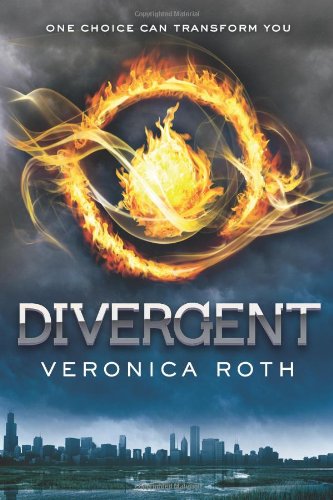
From Goodreads.com:
Everybody gets to be supermodel gorgeous. What could be wrong with that?
Tally is about to turn sixteen, and she can't wait. Not for her license -- for turning pretty. In Tally's world, your sixteenth birthday brings an operation that turns you from a repellent ugly into a stunningly attractive pretty and catapults you into a high-tech paradise where your only job is to have a really great time. In just a few weeks Tally will be there.
Tally is about to turn sixteen, and she can't wait. Not for her license -- for turning pretty. In Tally's world, your sixteenth birthday brings an operation that turns you from a repellent ugly into a stunningly attractive pretty and catapults you into a high-tech paradise where your only job is to have a really great time. In just a few weeks Tally will be there.
But Tally's new friend Shay isn't sure she wants to be pretty. She'd rather risk life on the outside. When Shay runs away, Tally learns about a whole new side of the pretty world -- and it isn't very pretty. The authorities offer Tally the worst choice she can imagine: find her friend and turn her in, or never turn pretty at all. The choice Tally makes changes her world forever.

Who doesn’t want to be pretty? Come on. Admit it. You KNOW you want to be thought of as pretty, handsome, beautiful even. It’s human nature isn’t it? That very idea is challenged in Scott Weterfeld’s book Uglies, the first in a series that deals with the themes of what is true beauty? And what happens when a society will go to any lengths to make sure every person is exactly the same? Set in an advanced, dystopian society, the novel tells the story of young adults who are challenged to think about and decide for themselves, what true beauty really is.
I enjoyed the challenging themes presented in the book, and think that it would make for some lively and interesting discussion with students. What does it mean to be beautiful? Can a person truly be beautiful if every person in the world looks the same? Tally’s ideas of ugly versus pretty are significantly challenged when she meets a group of people who have never had the operation that standardizes and optimizes people’s looks. Obviously, this isn’t a particularly original theme: Twilight Zone had an episode that dealt with this same concept. In it, a young woman is hideously ugly (even though to the TV audience she was quite beautiful) and it is revealed that she lives in a society where the truly beautiful people look like pigs. Like the Twilight Zone episode, Uglies had a twist that I didn’t see coming, and that made the ideas, which were not original, have a freshness that is more updated for the 21st century.
Like most dystopian novels, the setting is a city of the future, where some cataclysmic apocalypse has destroyed most of what readers know. The futuristic world of the book is a result of a virus that destroyed all petroleum, so the society had to find other technologies to support itself with. While there is not full development of the themes, there are many places where the novel touches on the ideas of “green” technologies, and how the people of the past, called “rusties” destroyed the world in which they lived through poor management of resources. One example of this happens when Tally discovers that the citizens of “the Smoke” (where those who refuse to have the operation escapes to live) have to cut down trees to have fuel, she is appalled. This could be another area where teachers could develop discussion and research points for students.
Overall Uglies is well written. While the primary audience is young adult, the language is not dumbed down in any way. There is strong vocabulary and active description throughout the novel. The scenes of Tally learning to “hover board” were exciting, and I imagine that anyone who has learned to skateboard and challenged themselves to do complicated tricks would relate to a futuristic styling of that activity. The action sequences seemed to have a “video game” kind of description, that would appeal to readers who enjoy those pursuits.
Overall I thoroughly enjoyed the novel, and intend to continue reading the series. I really want to know what happens after that cliff hanger ending! I recommend it as a DANGEROUS BOOK for students who want to read an action filled novel that will challenge them to think about what the future might look like under certain conditions, and I recommend it to teachers who want to challenge their students to develop independence in their thinking. Tally Youngblood is definitely a strong female heroine who can demonstrate that to students.