Showing posts with label Young Adult. Show all posts

Friday, August 19, 2011

Uglies by Scott Westerfeld

From Goodreads.com:

Everybody gets to be supermodel gorgeous. What could be wrong with that? 

Tally is about to turn sixteen, and she can't wait. Not for her license -- for turning pretty. In Tally's world, your sixteenth birthday brings an operation that turns you from a repellent ugly into a stunningly attractive pretty and catapults you into a high-tech paradise where your only job is to have a really great time. In just a few weeks Tally will be there.
But Tally's new friend Shay isn't sure she wants to be pretty. She'd rather risk life on the outside. When Shay runs away, Tally learns about a whole new side of the pretty world -- and it isn't very pretty. The authorities offer Tally the worst choice she can imagine: find her friend and turn her in, or never turn pretty at all. The choice Tally makes changes her world forever.

Uglies (Boxed Set): Uglies, Pretties, Specials (The Uglies)
Who doesn’t want to be pretty?  Come on.  Admit it.  You KNOW you want to be thought of as pretty, handsome, beautiful even.  It’s human nature isn’t it? That very idea is challenged in Scott Weterfeld’s book Uglies, the first in a series that deals with the themes of what is true beauty?  And what happens when a society will go to any lengths to make sure every person is exactly the same?  Set in an advanced, dystopian society, the novel tells the story of young adults who are challenged to think about and decide for themselves, what true beauty really is. 

I enjoyed the challenging themes presented in the book, and think that it would make for some lively and interesting discussion with students.   What does it mean to be beautiful?  Can a person truly be beautiful if every person in the world looks the same?  Tally’s ideas of ugly versus pretty are significantly challenged when she meets a group of people who have never had the operation that standardizes and optimizes people’s looks.  Obviously, this isn’t a particularly original theme:  Twilight Zone had an episode that dealt with this same concept.  In it, a young woman is hideously ugly (even though to the TV audience she was quite beautiful) and it is revealed that she lives in a society where the truly beautiful people look like pigs.  Like the Twilight Zone episode, Uglies had a twist that I didn’t see coming, and that made the ideas, which were not original, have a freshness that is more updated for the 21st century. 

Like most dystopian novels, the setting is a city of the future, where some cataclysmic apocalypse has destroyed most of what readers know.  The futuristic world of the book is a result of a virus that destroyed all petroleum, so the society had to find other technologies to support itself with.  While there is not full development of the themes, there are many places where the novel touches on the ideas of “green” technologies, and how the people of the past, called “rusties” destroyed the world in which they lived through poor management of resources.  One example of this happens when Tally discovers that the citizens of “the Smoke” (where those who refuse to have the operation escapes to live) have to cut down trees to have fuel, she is appalled.  This could be another area where teachers could develop discussion and research points for students. 


Overall Uglies is well written. While the primary audience is young adult, the language is not dumbed down in any way.  There is strong vocabulary and active description throughout the novel.  The scenes of Tally learning to “hover board” were exciting, and I imagine that anyone who has learned to skateboard and challenged themselves to do complicated tricks would relate to a futuristic styling of that activity.  The action sequences seemed to have a “video game” kind of description, that would appeal to readers who enjoy those pursuits.

Overall I thoroughly enjoyed the novel, and intend to continue reading the series.  I really want to know what happens after that cliff hanger ending!  I recommend it as a DANGEROUS BOOK for students who want to read an action filled novel that will challenge them to think about what the future might look like under certain conditions, and I recommend it to teachers who want to challenge their students to develop independence in their thinking.  Tally Youngblood is definitely a strong female heroine who can demonstrate that to students. 

Thursday, July 14, 2011

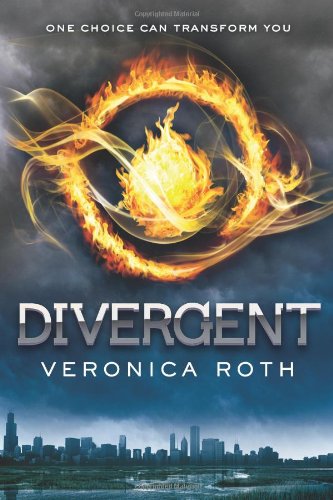
Divergent by Veronica Roth

According to Goodreads.com:

In Beatrice Prior's dystopian Chicago, society is divided into five factions, each dedicated to the cultivation of a particular virtue—Candor (the honest), Abnegation (the selfless), Dauntless (the brave), Amity (the peaceful), and Erudite (the intelligent). On an appointed day of every year, all sixteen-year-olds must select the faction to which they will devote the rest of their lives. For Beatrice, the decision is between staying with her family and being who she really is—she can't have both. So she makes a choice that surprises everyone, including herself. 

During the highly competitive initiation that follows, Beatrice renames herself Tris and struggles to determine who her friends really are—and where, exactly, a romance with a sometimes fascinating, sometimes infuriating boy fits into the life she's chosen. But Tris also has a secret, one she's kept hidden from everyone because she's been warned it can mean death. And as she discovers a growing conflict that threatens to unravel her seemingly perfect society, she also learns that her secret might help her save those she loves . . . or it might destroy her. 

Debut author Veronica Roth bursts onto the literary scene with the first book in the Divergent series—dystopian thrillers filled with electrifying decisions, heartbreaking betrayals, stunning consequences, and unexpected romance.

Divergent (Divergent, #1)

In recent months I have thoroughly glutted myself reading young adult dystopian fiction, a genre that is expanding exponentially these days, fueled by the highly successful Hunger Games series.  It’s a genre that I loved when I was in high school, and I have rediscovered this spring as I have read and enjoyed the plethora of well written young adult ventures into this style.  I have to say that Divergent  is a novel that I won’t soon forget, and I’ll be excited to know what happens next in the adventures of the heroine, Beatrice.

In Divergent author Veronica Roth has created a futuristic society of divided factions, each one dedicated to a particular virtue: honesty, selflessness, bravery, peacefulness, and intelligence.  Throughout the novel runs the theme of what does it mean to be a person who possesses these virtues?  Is it true that a person has one virtue to the exclusion of others?  And what are the true definitions of the virtues themselves?

I think Divergent is definitely a DANGEROUS BOOK as any reader will be compelled to examine their own lives in the light of the questions raised in the book.  As Tris (as the heroine Beatrice renames herself) questions what it means to be brave, readers will confront their inner fears.  Like other great dystopian novels, Divergent raises questions of morality, right and wrong, and our place in society. 

While there is no background information to explain how the world became this futuristic society and broke into the five factions, that did not detract from my enjoyment of the story.  As a reader, I didn’t even care about the missing information, because I was so drawn into the personalities of the characters in the story. 

The characters, Tris, her possible love interest, Four, and the other initiates, are well drawn.  Most of the characters have conflicting motivations, just as real humans do.  There is often no clear right and wrong answer to the challenges faced by Tris and the others, just as there is not often clear right and wrong answers in life.   The strong development of the character’s various personalities allows readers to imagine friends and family that we know, in similar situations. 

And even though this book offers a great deal of mental “meat” to chew on, it’s not missing elements of action and adventure.  Roth’s written descriptions of the feats Tris and the others face as they proceed through the Dauntless Faction’s initiation is extremely well done.  When Tris has to literally jump off a seven story building into seemingly nothingness below, it truly is a breath taking moment.  It’s the kind of action that I could see will easily translate to a movie version, and readers who enjoy fast paced action movies would easily be drawn to the excitement of the book.

Overall I highly recommend Divergent for readers who want a story that offers strong characters, amazing adventurous action, and the chance to think for ourselves in a world that seems to dictate to much of our thinking for us.  

Monday, July 4, 2011

Mrs. Peregrine's Home for Peculiar Children by Ransom Riggs


According to Goodreads.com:

A mysterious island. An abandoned orphanage. And a strange collection of very curious photographs. It all waits to be discovered in  Miss Peregrine’s Home for Peculiar Children, an unforgettable novel that mixes fiction and photography in a thrilling reading experience

I have to say that Mrs. Peregrine’s Home for Peculiar Children was a thoroughly enjoyable young adult novel.  I had expected to enjoy it, but not like it quite as much as I did.  That was a nice surprise.  In this book Riggs has captured just the right touch of suspense and excitement.  It gave me the heebie-jeebies in all the right places, but was still fun to read. 

The characters were well developed, with a mix of personalities and motivations.  Jacob, the lead character and narrator, was fully developed, and a strong male.  I think that boys in my classes will enjoy reading a book that doesn’t seem particularly “girlie” to them, and the good thing is that Jacob has a bit of romance during the story, so that might satisfy some of the girls in my classes.

 I also really appreciated the terrific vocabulary that Jacob, the first person narrator of the novel, used.  As a teacher I felt like this book could easily be used to do a wide ranging vocabulary study.  I will say that while I didn’t find Jacob’s cursing to be personally offensive (that would be hypocritical of me) there was some .  . . language . . . as we teachers in the Coalfields of West Virginia might say to each other.  I don’t remember it to be overwhelming or frequent, but then again, I’m no judge of that. 

The plot was exciting, with one large twist that I never saw coming, and I love it when I am caught totally by surprise in a book.  The setting was intriguing, with the idea of an island so isolated from the modern world that there is no cell service and only one phone for every inhabitant to use, and that setting really enhanced the plot. 

The thing that attracted me to the book originally was the fact that throughout the book are photographs of the “peculiar” children and inhabitants of the home.  I completely enjoyed them as I read (I had an electronic version of the book, and they were very nicely done there).  What really added to my enjoyment though, was the author’s note at the end that let me know every single photograph was real, and had been picked up from various yard sales, antique stores and similar places.  Riggs even gives a list of the collectors to whom the photographs belong.  That was exciting to me, and I had to go back through and look at them all again, imagining a writing invitation given to students with a number of old pictures, asking them to create a story around them to weave the pictures together.  I’ll have to work on that some, but I’ve got an idea for my classroom perking, thanks to that bit of information. 

Overall I highly recommend Mrs. Peregrine’s Home for Peculiar Children as a DANGEROUS BOOK.  It will be one that will make you enjoy the time you spend reading, catch student’s interest, and offer several entry points into writing practice.