Thursday, July 14, 2011

Divergent by Veronica Roth

According to Goodreads.com:

In Beatrice Prior's dystopian Chicago, society is divided into five factions, each dedicated to the cultivation of a particular virtue—Candor (the honest), Abnegation (the selfless), Dauntless (the brave), Amity (the peaceful), and Erudite (the intelligent). On an appointed day of every year, all sixteen-year-olds must select the faction to which they will devote the rest of their lives. For Beatrice, the decision is between staying with her family and being who she really is—she can't have both. So she makes a choice that surprises everyone, including herself. 

During the highly competitive initiation that follows, Beatrice renames herself Tris and struggles to determine who her friends really are—and where, exactly, a romance with a sometimes fascinating, sometimes infuriating boy fits into the life she's chosen. But Tris also has a secret, one she's kept hidden from everyone because she's been warned it can mean death. And as she discovers a growing conflict that threatens to unravel her seemingly perfect society, she also learns that her secret might help her save those she loves . . . or it might destroy her. 

Debut author Veronica Roth bursts onto the literary scene with the first book in the Divergent series—dystopian thrillers filled with electrifying decisions, heartbreaking betrayals, stunning consequences, and unexpected romance.
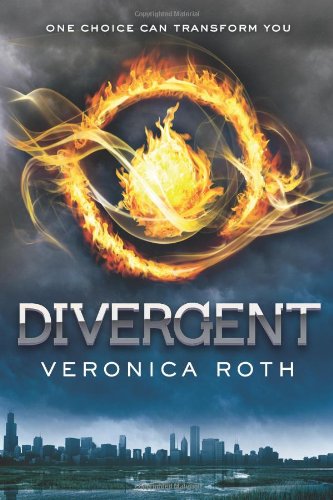
Divergent (Divergent, #1)

In recent months I have thoroughly glutted myself reading young adult dystopian fiction, a genre that is expanding exponentially these days, fueled by the highly successful Hunger Games series.  It’s a genre that I loved when I was in high school, and I have rediscovered this spring as I have read and enjoyed the plethora of well written young adult ventures into this style.  I have to say that Divergent  is a novel that I won’t soon forget, and I’ll be excited to know what happens next in the adventures of the heroine, Beatrice.

In Divergent author Veronica Roth has created a futuristic society of divided factions, each one dedicated to a particular virtue: honesty, selflessness, bravery, peacefulness, and intelligence.  Throughout the novel runs the theme of what does it mean to be a person who possesses these virtues?  Is it true that a person has one virtue to the exclusion of others?  And what are the true definitions of the virtues themselves?

I think Divergent is definitely a DANGEROUS BOOK as any reader will be compelled to examine their own lives in the light of the questions raised in the book.  As Tris (as the heroine Beatrice renames herself) questions what it means to be brave, readers will confront their inner fears.  Like other great dystopian novels, Divergent raises questions of morality, right and wrong, and our place in society. 

While there is no background information to explain how the world became this futuristic society and broke into the five factions, that did not detract from my enjoyment of the story.  As a reader, I didn’t even care about the missing information, because I was so drawn into the personalities of the characters in the story. 

The characters, Tris, her possible love interest, Four, and the other initiates, are well drawn.  Most of the characters have conflicting motivations, just as real humans do.  There is often no clear right and wrong answer to the challenges faced by Tris and the others, just as there is not often clear right and wrong answers in life.   The strong development of the character’s various personalities allows readers to imagine friends and family that we know, in similar situations. 

And even though this book offers a great deal of mental “meat” to chew on, it’s not missing elements of action and adventure.  Roth’s written descriptions of the feats Tris and the others face as they proceed through the Dauntless Faction’s initiation is extremely well done.  When Tris has to literally jump off a seven story building into seemingly nothingness below, it truly is a breath taking moment.  It’s the kind of action that I could see will easily translate to a movie version, and readers who enjoy fast paced action movies would easily be drawn to the excitement of the book.

Overall I highly recommend Divergent for readers who want a story that offers strong characters, amazing adventurous action, and the chance to think for ourselves in a world that seems to dictate to much of our thinking for us.  

Wednesday, July 13, 2011

The Enchantment Emporium by Tanya Huff

According to Goodreads.com:

Alysha Gale is a member of a family capable of changing the world with the charms they cast. Then she receives word that she's inherited her grandmother's junk shop in Calgary, only to discover upon arriving that she'll be serving the fey community. And when Alysha learns just how much trouble is brewing in Calgary, even calling in the family to help may not be enough to save the day.

The Enchantment Emporium

I want to go on record that I am a Tanya Huff fan.  As a lifetime reader of fantasy, science fiction, and supernatural stories (long before they were popular with the Twilight set) I have enjoyed several of Huff’s books completely.  Her writing is usually fast paced, with frequent references to pop culture and a great deal of humorous dialogue (and that’s usually not limited to just the human characters of her books).  As a fan of the Buffy the Vampire series on TV, I have often thought that Huff could have easily written for that show which also relied on snappy dialogue.   Other books of hers have had smart, quick plots, and supernatural elements that were enjoyable and, dare I say it, believable?  The Keep Series, with the talking magical cats, are some of my favorites, because I could imagine my geriatric old tom saying many of the things the cats in those books said.  But having said all the reasons why I have liked other Tanya Huff books that I read, let me say that the best thing The Enchantment Emporium  was the summary I found on Goodreads.com. 

From the opening chapter of The Enchantment Emporium I felt like I had been dumped into a blender with lots of action, about a thousand characters, and magical elements, with the blades chop chop chopping, and no way to make sense of the combinations. 

I often teach students to begin writing a story in the middle of the action as a hook to readers, then later move into narration. And Huff did the same. And then did more of it.  Then a little more.  She forgot the narration part.  After the first 50 pages I was so frustrated that I wanted to just quit, because I had no idea what was really going on.  There had been lots of action, lots of magic, and a whole passel of hints about underlying cause and effect, but truly, I was as lost as any reader could be.  I kept up though, because I was sure it would get better. 

I was wrong.

Another thing I found incredibly difficult about the story was the huge number of characters.  The lead character, Alysha, comes from a large family of magical witches.  Which is great.  I come from a large family too (and while some might be witches, they’re not magical, but that’s an entirely different blog entry).  But as a reader I had a terrible time sorting out who everyone was.  Part of the problem was the sheer numbers, but added to that were characters who had gender opposite names (Charlie is a girl I had to keep reminding myself) and characters who had both a name and a nickname, each frequently referenced.  Then there were multiple references to how these characters were related: whose aunt, whose cousin, whose sister’s brother’s ex-boyfriend’s gay boyfriend.  It was overwhelming.  As a reader all the relationship ins and outs just didn’t make the action or story of the book move along.  It added nothing, and detracted a great deal.

A third aspect of the book that I really disliked was the magical mechanism itself.  I’ve had 40+ years of experience reading supernatural/magical stories, so I know how to fall into a “wiling suspension of disbelief” with great ease.  But honestly, the mechanism of this magic I just could not bear.  While I understand and have no problem with the idea of magical families, this magical family was . . . incestuous.  While there weren’t any graphic depictions of sex,(although there was some strong and graphic language in parts) it was clear the cousins were sexually active with each other, an idea that I find reprehensible.  No matter how many times Huff wrote that the Aunties were “keeping the lines separate” to indicate that the cousins weren’t too genetically closely related to marry and procreate, I’m sorry, I just can’t believe it.  I come from a large family, raised closely together like the cousins in this book, and there is no way that a family raised that closely could grow up and look at each other as potential mates.  My ability to suspend my disbelief just doesn’t extend to long term, ingrained incest.  Certainly I’ve read my fair share of books with depictions of intercourse, but the idea of a large incestuous family that outsiders just determine is perfectly OK, that was just too gross for me to bear.

By the end of the book I had a clear idea of the story, the magic, and the characters, but there was nothing that I enjoyed.  This book will not become a Dangerous Book, because it truly had nothing redeeming to offer.  There is no one for whom I can recommend this book, and I will be deleting it from my Kindle roll, posthaste!. 


Monday, July 4, 2011

Mrs. Peregrine's Home for Peculiar Children by Ransom Riggs


According to Goodreads.com:

A mysterious island. An abandoned orphanage. And a strange collection of very curious photographs. It all waits to be discovered in  Miss Peregrine’s Home for Peculiar Children, an unforgettable novel that mixes fiction and photography in a thrilling reading experience

I have to say that Mrs. Peregrine’s Home for Peculiar Children was a thoroughly enjoyable young adult novel.  I had expected to enjoy it, but not like it quite as much as I did.  That was a nice surprise.  In this book Riggs has captured just the right touch of suspense and excitement.  It gave me the heebie-jeebies in all the right places, but was still fun to read. 

The characters were well developed, with a mix of personalities and motivations.  Jacob, the lead character and narrator, was fully developed, and a strong male.  I think that boys in my classes will enjoy reading a book that doesn’t seem particularly “girlie” to them, and the good thing is that Jacob has a bit of romance during the story, so that might satisfy some of the girls in my classes.

 I also really appreciated the terrific vocabulary that Jacob, the first person narrator of the novel, used.  As a teacher I felt like this book could easily be used to do a wide ranging vocabulary study.  I will say that while I didn’t find Jacob’s cursing to be personally offensive (that would be hypocritical of me) there was some .  . . language . . . as we teachers in the Coalfields of West Virginia might say to each other.  I don’t remember it to be overwhelming or frequent, but then again, I’m no judge of that. 

The plot was exciting, with one large twist that I never saw coming, and I love it when I am caught totally by surprise in a book.  The setting was intriguing, with the idea of an island so isolated from the modern world that there is no cell service and only one phone for every inhabitant to use, and that setting really enhanced the plot. 

The thing that attracted me to the book originally was the fact that throughout the book are photographs of the “peculiar” children and inhabitants of the home.  I completely enjoyed them as I read (I had an electronic version of the book, and they were very nicely done there).  What really added to my enjoyment though, was the author’s note at the end that let me know every single photograph was real, and had been picked up from various yard sales, antique stores and similar places.  Riggs even gives a list of the collectors to whom the photographs belong.  That was exciting to me, and I had to go back through and look at them all again, imagining a writing invitation given to students with a number of old pictures, asking them to create a story around them to weave the pictures together.  I’ll have to work on that some, but I’ve got an idea for my classroom perking, thanks to that bit of information. 

Overall I highly recommend Mrs. Peregrine’s Home for Peculiar Children as a DANGEROUS BOOK.  It will be one that will make you enjoy the time you spend reading, catch student’s interest, and offer several entry points into writing practice.